
SARAH FEENEY
WORDS: JUSTIN QUIRK

If you’ve been around fashion, trainers, brutalist architecture, skateboarding or independent booze in the last few decades, there’s a very good chance you’ve met Sarah Feeney. She did the remote working/digital native thing for years before it was even called that, connected brands like Puma with pop culture before they knew they needed it, is a partner in saucy French gin brand Sweet Gwendoline, and is currently in the process of sharing her phenomenal archive of British subculture, My Empire of Dirt. And before any of that she cut her teeth in some of the north’s pivotal clubs (she can pass for an honorary Londoner now though).
How do you describe what you do?
I guess it would be a brand development studio. It's always brands, and it's always the consumer facing side of it, and it's usually working on either brand refreshes or starting brands from scratch.
How did you get started?
I was working for a little record company. It was upstairs in this place in Camden, and my day would start sweeping mouse droppings off the desk. We had a Calor gas heater for the winter and we’d put faxes on top of it, and they'd go black, and we’d lose all these great record reviews. It was my job to press and organise the vinyl, and then I started sending out records to DJs and press.
I had a fella and he worked for Puma UK, who were getting a lot of stress from Puma International to pivot the brand and reposition it via music and entertainment. And he said, ‘Why don't you interview Sarah? Because she's from a fashion background, and she's working in the music business.’ That's how I got that job. It was because I worked in the record industry.
What was your first route into clubbing?
I grew up in Whythenshawe, then my parents moved to near Crewe, which was not great when you’re a kid. I used to go out in Manchester all the time and that's how I met Paul (Roberts) from K-Klass and why I ended up going to the Haçienda. That was kind of our crew. Then I got into Liverpool University, and so did my best friend Sarah. So my fella was Paul, hers was Darren Hughes. Me and Sarah lived together in Liverpool, so Paul and Darren got to know each other and became friends because we all shared the same house. And Paul’s manager was James Barton. So Darren and James got together to do this club: the first ever one was for Sarah's 21st party and then the second one was for my 21st and then the third one was so successful that they said let's do it for good. So that's how Cream started. And one of the reasons why it was working so well is because we were students, all our student friends were coming, but because James Barton was from Livepool, all the locals came too. So from the very first day you’ve got this amazing mix of people, which kind of set the precedent for that club. Traditionally, students only went to student nights, but Cream changed all that. It was always a melting pot of absolutely everybody.
What did you think you were going to do before clubbing intervened?
I used to watch The Clothes Show religiously, I would sit glued to it. I loved it and I think I always knew that I was going to try and get into some sort of fashion, music, creative, something, you know? I never thought I was going to go into something straight
Is there a tune that sums up that period up north for you?
I think for all of us, it's got to be something like Mr. Fingers, Can You Feel It, hasn’t it? That really changed it, but, being a northerner and going to the Haçienda, I also have another one. That club opened our eyes to music that could come in from these magical places called Chicago and Detroit we'd never been to, that we never thought we'd ever get to. At such a young age, it was profound. But then A Guy Called Gerald did Voodoo Ray, and that was almost purpose written for the Haçienda. It fitted in really well, because the sound in the Hacienda was fucking awful. It just boomed and echoed around. But the amazing thing about that song is that it benefits from that. It's very hypnotic. And that changed all our lives because that was the record that we thought, OK, so we can do this in our bedrooms. That was a pivotal track, made by someone from Manchester. That was the record that we all listened to and went, Oh, fuck yeah. We could do this.
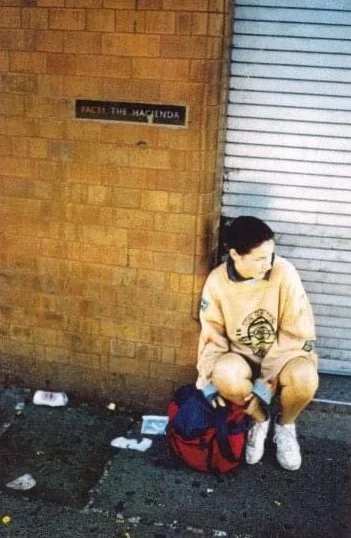
Outside the Haçienda circa 1990
What was your outfit back then?
The cool people that I know say it’s got to be the picture sat on the doorstep of the Haçienda the morning after the night before, wearing a Ton sur Ton sweatshirt and a pair of cycling shorts and a pair of Head trainers. But there’s another picture of me in the Haçienda, and I'm wearing a Joe Bloggs sweatshirt and my boyfriend’s jeans, so they’re really baggy. And if I'm really going to be honest, even though it's not the cooler outfit that's more indicative of what I would have actually been wearing then.
What would you like to bring back from that time?
I don't think I'd bring any of it back - the past is the past. But the thing that I most miss is Quadrant Park. It was short lived, even at the time. It didn't last very long, but it was just absolute Bedlam, a working class explosion. And the energy within the place was like England scoring in the dying minutes of the World Cup or something. It was phenomenal - people dancing on speakers, hanging off the ceiling. They were the happiest times, I thought they'd last forever. And it's mad when you realise that these things slip through your fingers. At the time it's like, Oh, that's fine, we'll go somewhere else. You don't pause to mourn something, because you don't feel it at the time. It sort of evolves into something else, and you move forward.
What do you think you learned from clubbing?
What didn’t I learn? It just totally informed the entire being I am now. I literally would not be the person I am if it hadn’t been for going to the Haçienda, going to the Kitchen in Hulme Crescents. At 16,17, 18, mixing with a whole variety of people and learning that, ultimately, it doesn’t matter who you are or where you’re from or what you do or your background, everybody comes together over the same things and the same love of things. I was blessed to learn about diversity, DIY, entrepreneurialism and just getting up and making things happen. And we completely took it for granted. So when I moved to London and I started to move in other circles, it was like, What do you mean, people don't like each other? It was inconceivable, because if you came out of that scene, you couldn’t imagine carrying that around with you, that sort of dislike for somebody for no good reason. I always thought that gratitude was about, Oh, I’ve got a roof over my head, and I've got a job, but it's not: I learned that gratitude is about not having to carry around bullshit. I would be completely different person had my life gone in a slightly different direction.
And finally, what was the last thing you went to that excited you?
Ekkstacy at Peckham Audio. Down an alleyway, there's like a ramen place upstairs, and it's all flyposted. It was absolutely tiny - I would imagine that they could claim much bigger venues than that. The mosh pit was alive and well - very happy to see it, but did not get involved in that, obviously. But that was a great gig.
Follow and subscribe to My Empire of Dirt here, or check Sarah’s work here